

Corporate Gamification: Benefits, Applications and Business Use Cases
Corporate gamification has become one of the most effective strategies for increasing employee participation, improving training outcomes, and strengthening the relationship between brands and their customers. By incorporating game mechanics such as rewards, levels, challenges, and scoring systems, organizations can transform traditional activities into far more engaging and motivating experiences.
While many people associate gamification exclusively with mobile applications or customer loyalty programs, this methodology is now widely used across training, sales, human resources, marketing, and digital transformation initiatives. More and more organizations are implementing gamified solutions to increase productivity, improve knowledge retention, and drive higher levels of engagement.
In this article, you will discover what corporate gamification is, how it works, its main benefits, and why it is becoming a strategic tool for organizations across virtually every industry.
What is Corporate Gamification?
Understanding corporate gamification means understanding how organizations can use game mechanics to motivate behaviors, increase participation, and achieve business objectives in a far more engaging way.
Gamification consists of integrating mechanics such as points, leaderboards, badges, rewards, challenges, and progression systems into activities that were not originally designed as games. The goal is not to turn work into a video game, but rather to leverage psychological principles related to motivation, competition, and recognition to encourage greater user engagement.
Today, companies across multiple industries use corporate gamification to optimize training programs, improve sales performance, strengthen customer loyalty initiatives, and enhance the experience of both employees and customers.
Its ability to increase engagement and transform repetitive tasks into more dynamic experiences has made corporate gamification a strategic tool within modern digital transformation initiatives.
How Does Corporate Gamification Work?
After understanding what corporate gamification is, it becomes easier to see why this methodology increases participation and improves outcomes across different areas of a business.
Corporate gamification works by incorporating game mechanics into traditional business activities in order to motivate specific behaviors and encourage greater user engagement.
Through reward systems, challenges, progression mechanics, and recognition, organizations can transform processes that would normally feel repetitive into more dynamic and engaging experiences.
Goals and Challenges
Every corporate gamification strategy begins with defining clear and measurable objectives.
Users receive specific challenges that they must complete in order to progress through the system, whether that involves finishing a training course, achieving sales targets, completing learning modules, or participating in company initiatives.
Having visible goals increases motivation and makes it easier to track progress.
Points and Rewards
Scoring systems are one of the most common components of gamification.
Employees or customers earn points by completing tasks, reaching goals, or participating in specific activities. These points can then be converted into rewards, benefits, or recognition that reinforce desired behaviors.
This mechanism creates a continuous sense of progress and achievement that significantly increases user engagement.
Levels and Progression
Progression is one of the most powerful psychological elements used in video games and one of the most effective within corporate gamification.
As participants complete activities, they unlock new levels, content, or more advanced challenges, creating a continuous sense of growth and development.
This dynamic is particularly effective in employee training and corporate learning programs.
Leaderboards and Recognition
Leaderboards and rankings encourage participation through healthy competition between employees or teams.
Displaying individual or team performance can increase engagement and motivate participants to continuously improve their results.
Additionally, public recognition of achievements often becomes a powerful incentive within corporate environments.
Instant Feedback
One of the most important aspects of corporate gamification is its ability to provide immediate feedback.
Users instantly know whether they have completed an activity successfully, how much progress they have made, and what steps they need to take next to continue advancing.
This immediate response significantly improves learning outcomes and increases knowledge retention.
Technologies Used in Corporate Gamification
The growth of corporate gamification has been driven by the evolution of technologies capable of creating more interactive, immersive, and personalized experiences.
Today, organizations can combine multiple technologies to develop solutions tailored to their specific goals and business needs.
Business Games
Many organizations implement gamification strategies through the development of business games improve processes, or strengthen company culture.
These solutions promote learning by doing and generate significantly higher levels of engagement than traditional methods.
Business Simulators
Business simulators represent one of the most advanced applications of gamification within corporate environments.
Through interactive scenarios, employees can practice real-world situations, make decisions, and learn in completely safe environments before facing real operational challenges.
Virtual Reality and Augmented Reality
The combination of gamification and immersive technologies has opened up new possibilities for organizations.
Today, many companies use virtual reality for business and augmented reality to develop immersive training experiences, interactive commercial solutions, and highly engaging learning environments.
Advergames and Interactive Marketing
Gamification has also become an extremely powerful marketing tool.
Advergames allow users to actively interact with a brand through playful experiences designed to increase engagement and improve brand recall.
Artificial Intelligence
Artificial intelligence is enabling increasingly personalized gamified experiences.
Modern systems can automatically adapt challenge difficulty, recommend specific content, and create experiences tailored to each user’s behavior and performance.
Benefits of Gamification for Businesses

After understanding how gamification for businesses works, it becomes easy to see why more and more organizations are incorporating it into their training, productivity, and digital transformation strategies.
Beyond simply making activities more enjoyable, gamification increases participation, improves knowledge retention, and generates higher levels of engagement among employees and customers.
Increases Employee Engagement
One of the main benefits of gamification for businesses is its ability to increase participation and engagement within organizations.
Reward systems, levels, and recognition mechanisms create greater motivation and encourage people to actively participate in the proposed activities.
This is especially valuable in training programs, onboarding processes, and human resources initiatives.
Improves Corporate Training
Traditional learning methodologies often suffer from low retention and participation rates.
By incorporating game mechanics, organizations enable employees to learn through practice and experimentation, making complex concepts easier to understand while improving knowledge retention.
Many companies complement these strategies with training simulators and business simulators, creating much more immersive and effective learning experiences.
Increases Productivity
Gamification for businesses can also be used to encourage the achievement of operational and commercial goals.
Employees receive continuous feedback on their performance, clearly visualize their progress, and feel more motivated to reach new milestones.
As a result, many organizations improve metrics related to sales, productivity, and operational efficiency.
Facilitates the Adoption of New Technologies
One of the biggest challenges during digital transformation processes is ensuring that teams adopt new tools and procedures.
Gamification reduces resistance to change by turning learning and technology adoption into a more engaging and participatory experience.
Enhances Customer Experience
Gamification not only benefits employees; it also enables organizations to create much more engaging customer experiences.
Loyalty programs, interactive applications, and digital experiences based on game mechanics increase interaction time and strengthen the relationship between brands and users.
These strategies are often complemented by advergames and 3D experiences for businesses, generating significantly higher levels of participation than traditional formats.
Improves Knowledge Retention
Numerous studies show that people remember what they actively experience far better than what they simply read or hear.
The incorporation of challenges, rewards, and active participation significantly improves knowledge retention and facilitates the transfer of skills to real work environments.
Use Cases of Gamification for Businesses
The versatility of gamification for businesses makes it possible to implement it in virtually every area of an organization.
From human resources to marketing, companies across industries are developing gamified experiences to improve processes and increase user engagement.
Training and Onboarding
Many organizations use gamification to accelerate employee onboarding and facilitate adaptation to the company environment.
Gamified onboarding processes improve participation and significantly reduce learning times.
Technical Training and Skill Development
The combination of gamification and training simulators creates safe environments where employees can practice complex procedures before facing real-world situations.
This is especially valuable in industrial, energy, and manufacturing sectors.
Human Resources
Human resources departments use gamification strategies to encourage participation in internal programs, performance evaluations, and initiatives related to company culture.
Sales and Commercial Teams
Many organizations implement leaderboards, challenges, and reward systems to encourage the achievement of sales objectives.
These dynamics increase team motivation and improve the performance of sales teams.
Marketing and Customer Loyalty
Marketing strategies also benefit greatly from gamification for businesses.
Users actively participate through interactive experiences that increase engagement and strengthen brand positioning.
In this area, advergames represent one of the most effective tools for connecting with audiences in a more engaging and memorable way.
Corporate Events and Trade Shows
An increasing number of organizations are developing gamified experiences for events, conferences, and trade shows.
These solutions increase attendee participation, improve brand recall, and collect valuable insights into user behavior through immersive and interactive experiences.
Gamification for Businesses vs. Traditional Training

After understanding the benefits of gamification for businesses, many organizations wonder whether it truly delivers better results than traditional training and learning methods.
Although conventional training programs continue to be useful in certain contexts, gamification introduces elements that significantly increase participation and knowledge retention.
The main difference lies in the role of the user within the learning process: while traditional training is often passive, gamification turns participants into active protagonists of the experience.
Active Participation
Traditional methods are typically based on presentations, manuals, and theoretical sessions where employees receive information passively.
In contrast, gamification for businesses promotes continuous participation through challenges, decisions, and interactive activities that maintain engagement throughout the entire process.
Improved Knowledge Retention
People remember what they experience and practice far better than what they simply read or hear.
By incorporating game mechanics, rewards, and active participation, gamification significantly improves knowledge retention and facilitates the practical application of newly acquired skills.
Immediate Feedback
One of the greatest benefits of gamification is its ability to provide continuous feedback to users.
Participants immediately know their results, identify areas for improvement, and can correct mistakes much faster than in traditional training environments.
Continuous Motivation
Progression systems, levels, and rewards create constant motivation to continue learning and improving.
This helps reduce dropout rates in training programs and significantly increases completion rates.
What Industries Use Gamification for Businesses?
Gamification for businesses has become a powerful tool used by organizations across virtually every industry.
Its ability to improve engagement, productivity, and learning makes it an adaptable solution for a wide range of business needs.
Human Resources
Human resources departments use gamification for onboarding processes, employee training, performance evaluations, and strengthening company culture.
These strategies increase participation and improve the employee experience throughout the entire employee lifecycle.
Manufacturing and Industry
Industrial companies use gamification to train operators, improve safety protocols, and optimize technical processes through interactive experiences and simulations.
In many cases, these solutions are complemented by training simulators and business simulators.
Corporate Learning
An increasing number of organizations are implementing gamified platforms for internal training programs and professional development initiatives.
These tools allow companies to personalize learning experiences and significantly increase participant engagement.
Marketing and Advertising
Brands use gamification for businesses to create more engaging campaigns and increase interaction with their audiences.
Advergames represent one of the best examples of how video games can strengthen brand positioning and improve brand recall.
Retail and Loyalty Programs
Points systems, rewards, and levels are part of many loyalty strategies used by retail and e-commerce businesses.
These initiatives increase customer retention and strengthen relationships between brands and their customers.
Technologies Used to Develop Gamification for Businesses
The success of a gamification for businesses project depends not only on the experience design but also on the technologies used during development.
Today, numerous tools make it possible to create experiences tailored to the objectives and requirements of each organization.
Unreal Engine
Unreal Engine enables the development of gamified experiences with photorealistic graphics, advanced simulations, and a high level of interaction.
It is particularly popular for projects involving training, simulators, and immersive experiences.
Unity
Unity is one of the most widely used platforms for developing gamified applications thanks to its flexibility and compatibility across multiple devices.
It enables the creation of business games, mobile applications, and interactive experiences tailored to different industries.
Artificial Intelligence
Artificial intelligence allows organizations to dynamically personalize each user’s experience, adjust challenge difficulty levels, and generate recommendations based on individual behavior.
This significantly increases the effectiveness of gamification strategies.
Virtual Reality and Augmented Reality
The integration of virtual reality for businesses and augmented reality is driving a new generation of gamified experiences that are far more immersive and effective.
These technologies are especially valuable for technical training, simulators, and brand experiences.
Web and Mobile Platforms
Many gamification solutions are developed as web or mobile applications that allow users to access the experience from virtually anywhere and on any device.
This facilitates adoption among organizations with distributed teams or hybrid work models.
How to Choose a Company Specialized in Corporate Gamification
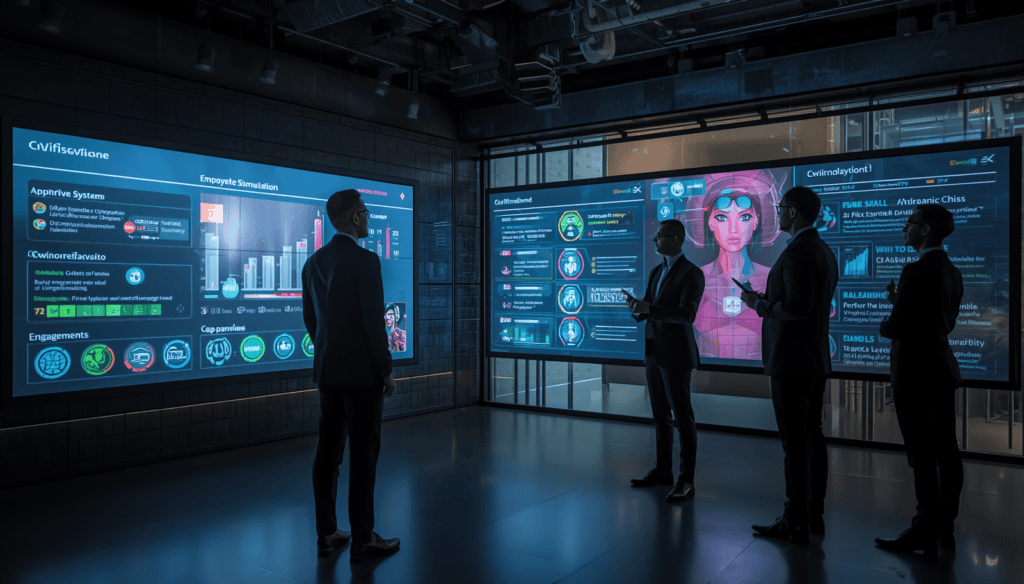
Implementing a corporate gamification strategy goes far beyond adding points, badges, or leaderboards to an application. The real value lies in designing experiences capable of changing behaviors, improving learning outcomes, and generating measurable results for the organization.
For this reason, choosing a technology partner with experience in enterprise projects is just as important as the technology used during development.
Experience in Enterprise Projects
Not every company that develops video games or interactive applications has experience creating solutions designed for corporate environments.
It is advisable to work with a team that understands processes related to training, human resources, sales, digital transformation, and customer experience, since each area requires different objectives, KPIs, and success metrics.
Expertise in Complementary Technologies
Modern corporate gamification solutions often combine multiple technologies to deliver more engaging and effective experiences.
A specialized company should be proficient in tools such as Unreal Engine, Unity, artificial intelligence, virtual reality, augmented reality, and web or mobile platforms in order to build solutions tailored to each organization’s specific needs.
Agile Methodologies
Developing projects using agile methodologies facilitates continuous validation, improves communication between teams, and allows new features to be adapted as business requirements evolve.
This approach reduces risk and accelerates implementation timelines.
Scalability
A successful gamification strategy should evolve alongside the company.
For this reason, it is important to build platforms and experiences that are prepared to incorporate new features, users, and integrations without requiring the entire solution to be rebuilt in the future.
Why Choose Fryos Studios for Corporate Gamification Projects?
At Fryos Studios, we help organizations transform traditional processes into interactive experiences through technologies such as business games, simulators, virtual reality, augmented reality, and artificial intelligence.
Our team develops customized solutions tailored to the needs of each company, combining creativity, design, and technology to create experiences that improve training outcomes, increase engagement, and strengthen business strategies.
We work on projects related to business games, business simulators, advergames, virtual reality for businesses, and immersive experiences designed to accelerate digital transformation within organizations.
Our goal is not simply to develop innovative technology, but to build scalable solutions that generate measurable results and deliver real value to every client.
Frequently Asked Questions About Corporate Gamification
Corporate gamification involves using game mechanics such as points, levels, rewards, and challenges to improve participation, learning, and engagement within an organization.
Some of its main benefits include increased engagement, improved training outcomes, higher productivity, and better knowledge retention.
No.
Today, gamification is also widely used in sales, human resources, marketing, customer loyalty programs, onboarding, and digital transformation initiatives.
Gamification introduces game mechanics into existing processes, while business games are complete experiences specifically designed to achieve business objectives through video game-based solutions.
Yes.
More and more organizations are combining corporate gamification with virtual reality for businesses and augmented reality to create significantly more immersive and effective experiences.
Yes.
At Fryos Studios, we develop gamification solutions using business games, simulators, virtual reality, augmented reality, and artificial intelligence to help organizations innovate and improve their processes.
Conclusion
Corporate gamification has become one of the most effective tools for improving engagement, strengthening training programs, and accelerating digital transformation within organizations.
Its ability to combine motivation, learning, and technology makes it possible to create highly engaging experiences for both employees and customers while generating measurable improvements in productivity, engagement, and knowledge retention.
As technologies such as artificial intelligence, virtual reality, and simulators continue to evolve, gamification will play an increasingly important role in the way companies train employees, sell products, and interact with their audiences.
Looking to Develop a Corporate Gamification Project?
At Fryos Studios, we help organizations create corporate gamification solutions, business games, interactive simulators, immersive experiences, and custom applications using technologies such as Unreal Engine, Unity, virtual reality, and artificial intelligence.
If you are looking for a technology partner to transform an idea into an innovative digital experience, our team is ready to support you throughout every stage of the project.