
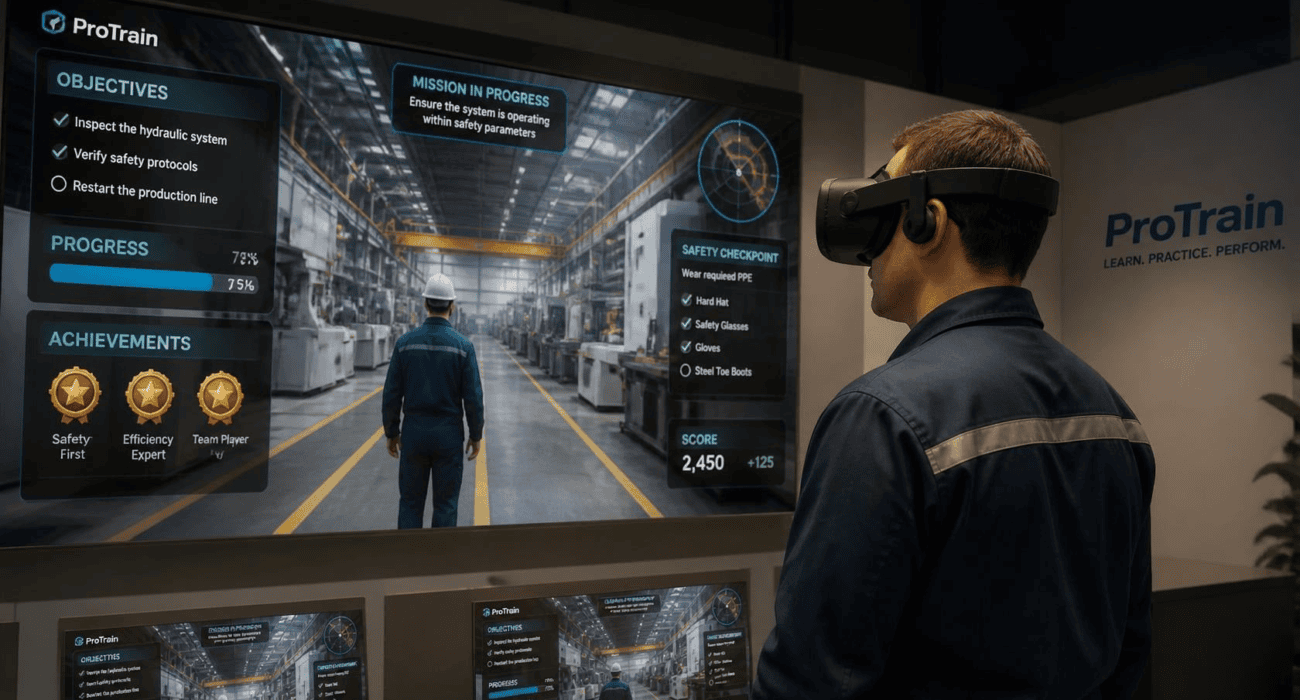
Reducing Industrial Risks: How Virtual Reality Training Simulators Save Lives and Lower Costs
Workplace safety has always been a top priority for companies operating in industries such as manufacturing, oil and gas, energy, mining, construction, and logistics. However, traditional training methods often fail to adequately prepare employees for high-risk situations and complex operational procedures in real-world environments.
As a result, virtual reality training simulators have emerged as one of the most effective technologies for reducing industrial risks, improving workforce readiness, and lowering the costs associated with workplace accidents, operational errors, and employee training.
Using industrial virtual reality, organizations can recreate complex scenarios where employees practice procedures, make decisions, and respond to critical situations without being exposed to real danger. This hands-on approach allows workers to develop practical skills through direct experience, increasing confidence and knowledge retention before entering the workplace.
Beyond improving safety, immersive VR simulators also help reduce training time, minimize operational downtime, and optimize the use of equipment, making them a strategic investment for companies seeking to increase productivity and accelerate their digital transformation initiatives.
In this article, you’ll learn how virtual reality training simulators help reduce industrial risks, explore their key benefits, and discover why more organizations are integrating this technology into their corporate training programs.
Why Traditional Training Methods Are No Longer Enough
For decades, most organizations have relied on classroom instruction, technical manuals, presentations, and live demonstrations using real equipment or facilities to train their workforce.
While these methods remain valuable for sharing information, they present significant limitations when the goal is to prepare employees to respond effectively to hazardous situations or perform complex operational procedures.
One of the biggest challenges is that traditional learning is largely passive. Employees receive instructions, watch demonstrations, or read documentation, but they have very few opportunities to practice before performing tasks in real working environments.
Additionally, many companies limit hands-on training due to safety concerns, equipment availability, or operational costs. As a result, workers often gain experience directly on the job, increasing the likelihood of mistakes that can lead to accidents, equipment damage, or production downtime.
Virtual reality training simulators solve this challenge by providing a completely safe environment where users can repeat procedures, make mistakes, learn from them, and refine their skills without putting people, machinery, or facilities at risk.
For this reason, more companies are complementing traditional training with solutions such as Virtual Reality for Business and Business Simulators, creating training programs that are far more effective, measurable, and scalable.
What Are Virtual Reality Training Simulators?
Virtual reality training simulators are immersive applications that recreate real-world scenarios using advanced 3D technology, allowing users to interact with equipment, tools, operational processes, and workplace situations within a fully virtual environment.
Unlike conventional training, where participants simply watch or listen, a VR simulator places the user at the center of the experience. Using a virtual reality headset and specialized controllers, employees can move through realistic environments, manipulate objects, perform procedures, and make decisions as if they were working in real-life conditions.
This experiential learning approach commonly known as learning by doing helps users develop practical skills, improves knowledge retention, and builds confidence before they perform tasks in the real workplace.
Today, virtual reality training simulators are widely used to train employees in industrial procedures, workplace safety protocols, equipment maintenance, emergency response, heavy machinery operation, and many other high-risk activities where human error can have serious consequences.
In addition, these solutions can be integrated with Immersive Experiences for Business, artificial intelligence, and data analytics to create increasingly personalized, measurable, and efficient corporate training programs.
What Industrial Risks Can Be Simulated with Virtual Reality?
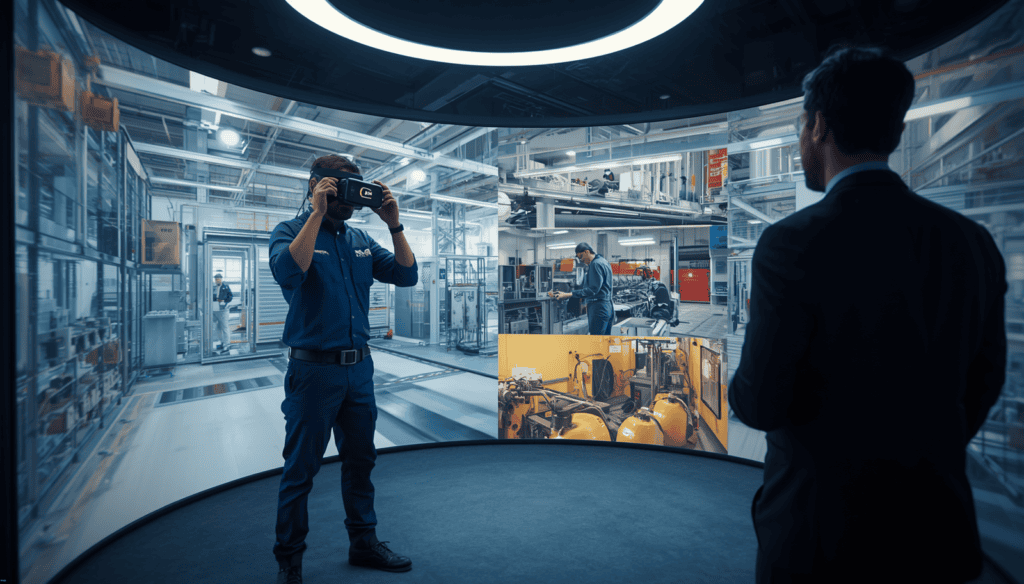
One of the greatest advantages of virtual reality training simulators is their ability to recreate high-risk scenarios without exposing employees to dangerous situations. This allows users to practice complex procedures as many times as necessary before performing them in real-world environments.
Today, companies across multiple industries use VR simulators for businesses to train their workforce in critical operations, strengthen compliance with safety protocols, and significantly reduce the likelihood of workplace accidents.
Heavy Equipment Operation
Operating cranes, forklifts, excavators, and other industrial machinery requires precision, experience, and a thorough understanding of safety procedures.
Using virtual reality training simulators, operators can learn how to control equipment, respond to mechanical failures, and perform complex maneuvers in a completely safe environment. This reduces the risk of equipment damage, workplace accidents, and costly downtime during the learning process.
Working at Heights
Tasks performed on elevated platforms, scaffolding, or industrial structures represent one of the highest workplace risks across many industries.
VR simulators allow employees to practice the proper use of personal protective equipment (PPE), identify potential hazards, and perform safe work procedures before facing real working conditions.
This hands-on preparation increases worker confidence and reinforces a strong safety culture throughout the organization.
Confined Spaces
Entering tanks, tunnels, silos, or underground chambers requires strict compliance with safety protocols to prevent incidents involving hazardous gases, oxygen deficiency, or difficult evacuation procedures.
With industrial virtual reality, companies can recreate these confined environments and train personnel on entry procedures, monitoring, communication, and emergency response without putting anyone at risk.
Electrical Hazards
Working with electrical installations demands precision to prevent electric shocks, short circuits, and potentially fatal accidents.
Industrial training simulators enable employees to practice procedures such as Lockout/Tagout (LOTO), inspections, preventive maintenance, and electrical system interventions while reinforcing compliance with workplace safety standards.
Industrial Emergencies
Organizations also use VR simulators to prepare employees for critical situations that, while infrequent, can have severe consequences.
Common scenarios include:
- Hazardous material spills
- Gas leaks
- Explosions
- Equipment failures
- Emergency evacuation procedures
- Emergency response operations
By repeatedly practicing these situations in a virtual environment, employees develop faster reaction times, greater confidence, and better decision making skills when real emergencies occur.
Benefits of Implementing Virtual Reality Training Simulators in Industry
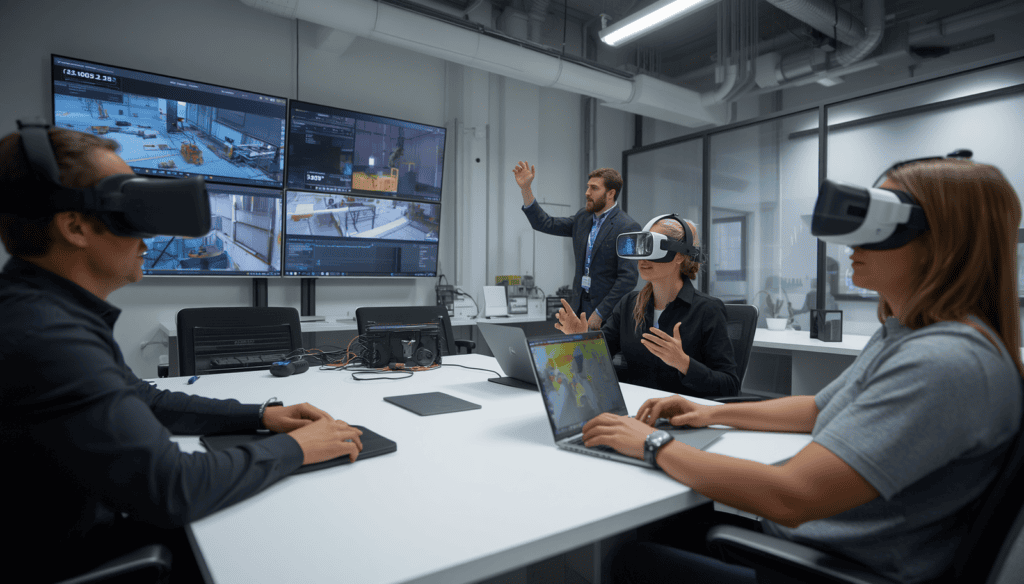
Implementing virtual reality training simulators goes far beyond improving workplace safety. These solutions also deliver measurable operational and financial benefits for organizations.
By combining hands-on learning, performance analytics, and completely risk-free training environments, VR has become a strategic technology for companies looking to modernize their workforce development programs.
Reduced Workplace Accidents
The primary benefit of VR simulators is reducing employee exposure to risk during training.
Workers can make mistakes, repeat procedures, and learn through experience without putting themselves, their coworkers, or company assets in danger.
As a result, many organizations experience fewer workplace incidents while strengthening their overall safety performance.
Improved Knowledge Retention
Research consistently shows that people remember what they actively experience far better than what they simply read or hear.
Immersive training allows employees to participate directly in realistic work scenarios, significantly improving understanding and long-term retention of critical procedures.
Lower Operational Costs
Virtual reality training simulators help companies reduce expenses associated with equipment used for training, material consumption, instructor travel, and production downtime.
Additionally, a single simulator can be reused indefinitely to train new employees, maximizing return on investment over time.
Increased Productivity
Employees who enter the workplace better prepared require less supervision and reach peak performance more quickly.
This shortens onboarding periods, improves operational efficiency, and reduces errors when performing critical tasks.
Objective Performance Evaluation
Unlike traditional training methods, VR simulators automatically collect detailed performance data during every training session.
Organizations can analyze metrics such as:
- Task completion time
- Number of mistakes made
- Decision-making performance
- Safety protocol compliance
- Progress over time
- Individual performance results
This data provides valuable insights for managers and training teams, enabling them to make informed decisions and personalize future training programs based on each employee’s performance and development needs.
How Much Money Can a Company Save with Virtual Reality Training Simulators?
Although many organizations view virtual reality training simulators as a significant investment, the greatest financial impact comes from the long term savings they generate.
Beyond the initial development cost, these solutions help reduce workplace accidents, shorten training time, optimize equipment usage, and improve employee performance all factors that directly contribute to a company’s profitability.
For this reason, more organizations evaluate VR training projects using Return on Investment (ROI) metrics, comparing the initial investment with the financial benefits achieved over time.
Lower Training Costs
Traditional training programs often require specialized instructors, employee travel, printed materials, and, in many cases, partial production shutdowns while training takes place.
With virtual reality training simulators, many of these expenses are eliminated.
Once the solution has been developed, employees can complete training as many times as necessary without disrupting operations or using real equipment.
This significantly lowers the cost per trained employee, especially for organizations with high staff turnover or recurring training requirements.
Fewer Accidents, Lower Financial Losses
Every workplace accident creates both direct and indirect costs for an organization.
In addition to personal injuries, companies may face:
- Equipment damage
- Production downtime
- Employee compensation claims
- Internal investigations
- Legal expenses
- Regulatory fines
- Reputational damage
By allowing employees to practice procedures in a completely safe environment, industrial virtual reality helps reduce the likelihood of workplace incidents while strengthening the company’s overall safety culture.
Faster Productivity from Day One
Employees who arrive better prepared require less supervision and reach full productivity much faster.
VR simulators for businesses allow workers to repeat procedures until they master every task, reducing operational errors and accelerating the onboarding process.
Over time, these productivity improvements translate into substantial financial benefits for the organization.
A Practical ROI Example
Imagine a manufacturing company that trains 300 employees every year to operate industrial machinery.
Before implementing a virtual reality training simulator, the company incurred costs related to:
- Classroom training sessions
- Using production equipment for training
- Specialized instructors
- Printed training materials
- Partial production downtime
After deploying an immersive VR simulator, the company achieved:
- 40% reduction in training time
- Reduced use of machinery for training purposes
- Fewer mistakes during employee onboarding
- More standardized training processes
- Fewer incidents caused by human error
Although the initial investment may exceed the cost of traditional training, the accumulated savings allow the project to pay for itself within a relatively short period especially when the simulator is used for several years and trains hundreds of employees.
For this reason, virtual reality training simulators should be viewed as a strategic investment rather than simply another technology expense.
Virtual Reality Training Simulators vs. Traditional Training
The differences between these two approaches go far beyond the technology itself. While traditional training focuses primarily on delivering information, virtual reality places employees inside realistic environments where they learn by doing.
| Category | Virtual Reality Training Simulators | Traditional Training |
|---|---|---|
| Training Safety | Very High | Depends on the real environment |
| Practice of Critical Scenarios | Unlimited | Limited |
| Use of Real Equipment | Usually Not Required | Required |
| Risk to Employees | Very Low | Medium to High |
| Procedure Repetition | Unlimited | Limited by time and cost |
| Performance Measurement | Automatic through analytics | Primarily manual |
| Scalability | High | Medium |
| Knowledge Retention | High | Moderate |
This comparison explains why more organizations are integrating virtual reality training simulators into their workforce development programs, either complementing or partially replacing traditional training methods.
Which Industries Benefit the Most?
Although immersive simulators can be implemented across virtually any industry, some sectors experience particularly significant benefits due to their operational risks and the high cost of employee training.
Manufacturing
Manufacturing companies use VR simulators to train machine operators, improve production processes, and reinforce safety procedures while reducing errors and shortening learning curves.
Oil, Gas, and Energy
In industries where a single mistake can have severe consequences, industrial virtual reality enables employees to practice critical procedures without exposure to real hazards.
Construction
VR simulators prepare workers for tasks such as working at heights, operating heavy equipment, and following safety protocols before they enter active construction sites.
Mining
Immersive training makes it possible to simulate challenging mining environments, allowing employees to practice operational procedures and emergency response in realistic conditions without compromising safety.
Logistics and Transportation
Companies in logistics use simulators to train forklift operators, drivers, and warehouse personnel, improving both workplace safety and operational efficiency.
Healthcare
Hospitals, medical schools, and healthcare organizations use VR simulators to practice medical procedures, emergency response, and clinical protocols without putting patients at risk.
How to Implement a Virtual Reality Training Simulator Project in Your Company
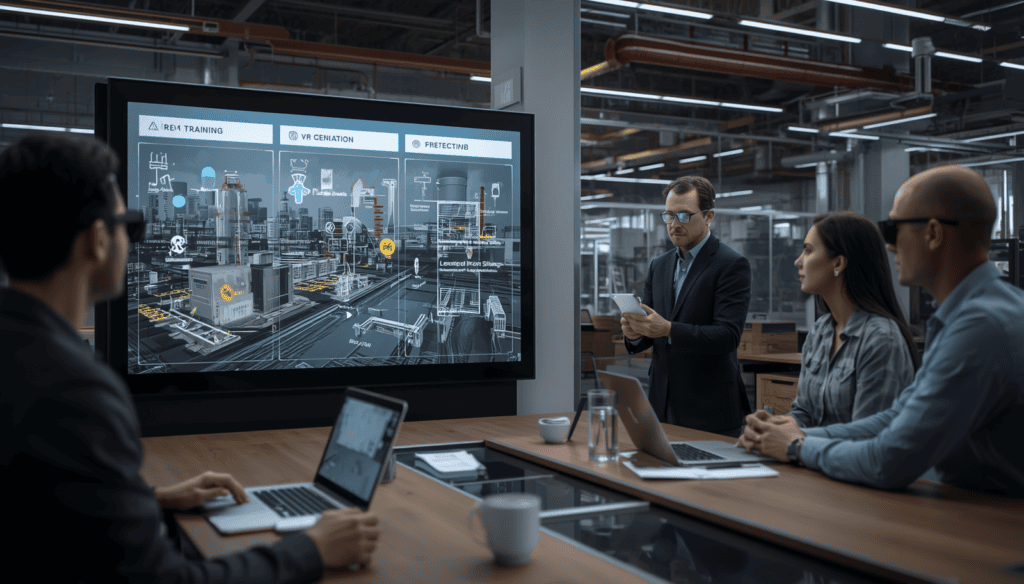
The success of a virtual reality training simulator project depends on much more than the technology itself. Organizations must first define clear objectives, understand their operational challenges, and design an immersive experience that delivers measurable value for both employees and the business.
A well planned implementation helps reduce operational risks, optimize training time, and maximize return on investment.
Identify Critical Business Processes
The first step is identifying the activities that involve the highest level of risk, generate the most operational errors, or require continuous employee training.
Processes that typically benefit the most from VR simulators include:
- Heavy equipment operation
- Maintenance procedures
- Safety protocols
- Working at heights
- Confined space operations
- Emergency response training
- Employee onboarding programs
Prioritizing these areas allows organizations to achieve faster results and greater business impact.
Design Realistic Training Environments
The effectiveness of a VR simulator depends largely on how accurately it recreates the real working environment.
To maximize immersion, companies should replicate:
- Actual facilities
- Company-specific equipment
- Standard operating procedures
- Common workplace hazards
- Everyday operating conditions
The closer the virtual environment matches reality, the easier it becomes for employees to transfer what they learn into real-world performance.
Measure Employee Performance
One of the greatest advantages of virtual reality training simulators is their ability to collect detailed performance data during every training session.
Organizations can track metrics such as:
- Task completion time
- Number of errors
- Compliance with safety procedures
- Accuracy and precision
- Learning progress over time
- Individual and team performance
These insights support better decision-making while enabling continuous improvements to corporate training programs.
Update and Scale the Solution
Industrial operations continuously evolve. For this reason, a well-designed VR solution should be flexible enough to incorporate new procedures, equipment, or training scenarios without requiring the entire application to be rebuilt.
This scalability allows organizations to continue benefiting from the simulator for many years while adapting it to business growth and operational changes.
Why Choose Fryos Studios for Virtual Reality Training Simulators?
At Fryos Studios, we help organizations modernize their training processes through custom built virtual reality simulators designed specifically for each industry.
Our multidisciplinary team combines expertise in software development, game development, 3D modeling, and immersive technologies to create realistic training environments where employees can safely develop technical skills and operational expertise.
We develop solutions including virtual reality for businesses, business simulators, immersive business experiences, and business games, leveraging technologies such as Unreal Engine, Unity, and artificial intelligence to deliver scalable solutions tailored to each client’s objectives.
Our mission goes beyond building innovative technology we help organizations reduce risk, improve productivity, and generate measurable business results through immersive training solutions.
Frequently Asked Questions About Virtual Reality Training Simulators
Virtual reality training simulators are immersive 3D applications that recreate real-world environments, allowing users to practice procedures, make decisions, and develop practical skills within a completely safe virtual environment.
Key benefits include reduced workplace accidents, improved knowledge retention, lower training costs, increased productivity, and objective employee performance evaluation.
Industries including manufacturing, oil and gas, energy, mining, construction, logistics, transportation, and healthcare use VR simulators to train employees, improve operational performance, and strengthen workplace safety.
Not necessarily.
In most cases, both approaches complement each other. Virtual reality allows employees to practice procedures before performing them in real-life situations, significantly improving learning effectiveness.
ROI can be calculated by evaluating factors such as fewer workplace accidents, lower training costs, shorter onboarding times, higher productivity, and fewer operational errors.
Yes.
At Fryos Studios, we develop fully customized virtual reality training simulators tailored to each organization’s needs. Using technologies such as Unreal Engine, Unity, artificial intelligence, and immersive experiences, we create solutions designed to deliver measurable business outcomes.
Conclusion
Virtual reality training simulators are transforming the way organizations approach employee training and industrial safety. By allowing employees to practice in safe, realistic environments, companies reduce operational risks, improve knowledge retention, and optimize workforce performance.
Beyond being an innovative technology, these immersive solutions help reduce workplace accidents, lower training expenses, and accelerate employee readiness creating measurable improvements in both productivity and business profitability.
As digital transformation continues to reshape industries, virtual reality is becoming an essential tool for organizations seeking to strengthen workplace safety, improve employee performance, and remain competitive in an increasingly demanding market.
Looking to Implement Virtual Reality Training Simulators in Your Company?
At Fryos Studios, we develop custom virtual reality simulators for industrial training, technical education, and enterprise learning. Using Unreal Engine, Unity, and artificial intelligence, we create immersive experiences that deliver measurable business results.
If you’re ready to reduce operational risks, improve workforce training, and accelerate your organization’s digital transformation, we’re ready to help.